In March of 2010 I wrote an opinion piece regarding the differences between the politics of business and the politics of healthcare. With the recent Supreme Court Hearings coming to a close, I thought it would be appropriate to re-post this to see how true it still may be. Enjoy!
======================================================================================
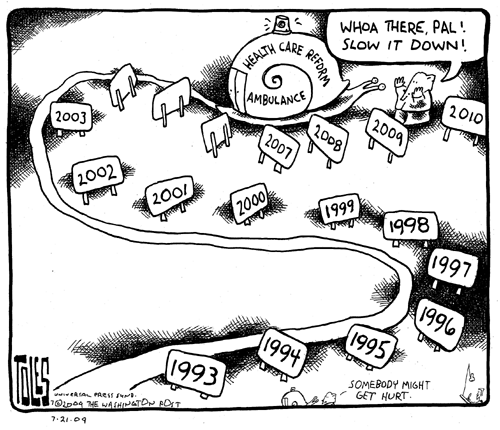
Doesn’t matter who you are, where you come from or what economic status you fall under; the Health care argument is a topic that none of us can ignore. Today, a historic vote is about to take place. Will it end with this vote? Does any piece of legislation ever end with one vote, of course not!
No one is an expert. Guess what, if you are a person, politician…a republican, democrat, independent or even Regina M. Benjamin… you are not an expert on Health care. You may have more practice and information than others but you are not an expert. I say this because the basics of health care in this country, the business of it, and the policies that are amended change. This machine continues to evolve. Your opinion and fact, while true at the moment, could be obsolete within 6 months.
The Problem with Health Care & Politics:

- One Argument Against
The fundamental problem with politics is that people are behind it. We as humans have differences in philosophy, understanding and information. Those factors are then framed within a silo of our own opinions. We then use those opinions to argue, push or influence what we believe to be right.
“The belief that there is only one truth, and that oneself
is in possession of it, is the root of all evil in the world”
The thing about an opinion is that everyone has one, which is why politicians in the house, the senate, congress and the executive branch will not be able to come up with one plan, one approach, one bill that will solve everything. Should that stop us from gaining progress to fix the system?
The Problem with Business & Politics:
The fundamentals of business do not at all coincide with the thoughts and approaches of “Health Care (caring for a person) & Politics.” The politics of business is to make the business money. Yes we hope that a business will have what we all believe are morals. We hope that the business will do what is in the best interest of the customers, employees, clients and patients. However we must not ignore that if the business behind the machine that is providing Health care does not make money then they can no longer provide care.
Cost versus Consequences: The estimated cost to either fix or overhaul the system is close to 1 trillion dollars. I am not an expert but I believe that if any decision is to be made, then you first have to know the facts that are presented (most recent versions I found):
Health care Bill (Summary) and Health care Bill (Full Version)
While the cost to take care of things now may be large, how much will it be if we don’t? In August of last year CBS News had a report of How Much Health Care Reform will cost. Here is one Doctor’s opinion of why Health care Reform Needs to Pass Now. Whether you agree with it or not, don’t just have an opinion (they are a nickel a dozen) have an opinion based off valid information (yeah, that’s easy huh).
Synopsis – Take a stance:
I have referenced to many aspects of the argument. The thing that matters to me the most is that we, our representatives (whether you agree that they represent you or not) and business take a stance. No more waiting, no more political maneuvering. Any politician that is fearful of losing their job based on a vote, probably should have never had the job in the first place. Regardless, do what you feel is best. Not for politics, not for your employer, but what you feel deep down in your gut should be done.
What are your heartfelt opinions? Have you even given any thought to it?
Stay informed - more thoughts on the topic:
“Healthcare – US Bureau of Labor Statistics”
“HR Bloggers Silence on Health Care Reform” by Krista Ogburn Francis
“Death, Health care, and the employer albatross” by Mark Stelzner
“The Vote on Healthcare and the Future of Work” by Sharlyn Lauby
“Lessons from Health Care: The Semantics of Power” by Jason Seiden
“Healthcare Reform Blog” by Alan Katz
“The Healthcare Blog”